
A beginner’s UK guide
Your first live poker tournament.
Your first live poker tournament can feel intimidating before you have even been dealt a card. Where do you register? How much money should you bring? What happens if you accidentally do something wrong?

In this guide
Start with a tournament you can comfortably afford, check the venue’s entry requirements and arrive early enough to settle in. Once seated, follow the action and ask the dealer whenever a procedure is unclear.
Get to know the game
What happens at a live poker tournament?
In a standard poker tournament, you pay an entry cost and receive a starting stack of tournament chips. You compete against other players, with prizes awarded according to the event’s payout structure.
The blinds increase as the tournament progresses. Players who lose their chips are eliminated, although some formats allow another entry or a rebuy. See PokerStars’ explanation of tournament formats.
Find your starting point
How to choose your first live poker tournament
Choose an event by its cost, format and schedule. A local tournament with an affordable entry and a clearly explained structure is a sensible starting point.
You might recognise the World Series of Poker, World Poker Tour or European Poker Tour from broadcasts. Your own first event can be a much simpler evening in a nearby poker room.
Compare the starting stack with the opening blinds. For example, 20,000 chips at blinds of 100/200 gives you 100 big blinds. The same stack at 500/1,000 gives you 20. The headline chip count alone tells only part of the story.
Check the length of each blind level too. Longer levels allow more time before the forced bets rise, while faster structures can put pressure on stacks sooner.
Ask whether the event is dealer-dealt and suitable for someone new to live poker. Knowing who handles the cards and chips removes another uncertainty before you arrive.
Know the full cost
Understand buy-ins, fees and your total budget
An advertised entry may separate the prize-pool contribution from the fee. In a hypothetical £40 + £10 event, you would pay £50: £40 towards the prize pool and £10 as the fee. Check the organiser’s breakdown for additional charges. PokerStars explains this fee split.
Your budget should also cover transport, parking, food and any other planned spending. Keep the money you need to get home separate from your playing budget.
Decide your maximum gambling spend before leaving. If your plan is one entry, stick to it even if you are eliminated early. Losing the buy-in is a possible outcome, including when you make reasonable decisions.
Treat the cost as entertainment spending you can afford to lose. Neither a large guarantee nor a promising starting hand makes a tournament a reliable way to earn money.

Freezeout, rebuy or re-entry?
These labels explain whether you can buy more chips or enter again:
- Freezeout once you lose all your chips, your tournament is over.
- Rebuy you may buy more chips during a specified period if the event’s conditions allow it.
- Re-entry after elimination, you may register again for a new entry while registration remains open, subject to any entry limit.
Some events also offer an add-on: an additional purchase of chips at a specified point. Check the individual structure. These distinctions are explained in Darren Elias’s tournament format guide.
A freezeout can make budgeting simpler because there is no second entry to consider. In any format, confirm the complete cost before paying.
Before you leave home
What to check before visiting the casino
Contact the venue or read its current visitor information before travelling. Check these details:
- Which photographic identification it accepts.
- Whether you need membership or an account, and how to arrange it.
- Whether tournament registration is online, in person or both.
- Which payment methods are accepted for that event.
- The dress code, start time and registration deadline.
- Whether seats can sell out or there is a waiting list.
Bring the requested identification even if you registered online. For example, Grosvenor’s visitor guidance specifies valid photo ID, while stating that ordinary visits do not require membership. Check your chosen event’s requirements separately.
Aim to arrive around 30–45 minutes early, allowing more time if the venue recommends it. That gives you room to sort out reception, find the poker room and ask questions without rushing.
Wear something comfortable that meets the dress code. A light extra layer, charged phone and a plan for getting home are useful practical preparations.
From screen to felt
Moving from online poker to live poker
If you have been playing online, you may already understand the betting rounds. Live poker games add the physical tasks: counting chips, following the action and clearly communicating your decisions.
Before attending a Texas Hold’em event, refresh the hand rankings and the meaning of check, bet, call, raise and fold. Understand how the flop, turn and river complete the board. PokerStars’ poker rules provide a reference for these basics.
Practise counting a few different chip combinations at home. You do not need fancy chip tricks; being able to count a bet calmly is more useful.
Expect pauses for dealing, chip counts and decisions. Use that time to follow what is happening. Avoid trying to fill every quiet moment by entering another hand.

Your arrival, made simpler
Arriving, registering and finding your seat
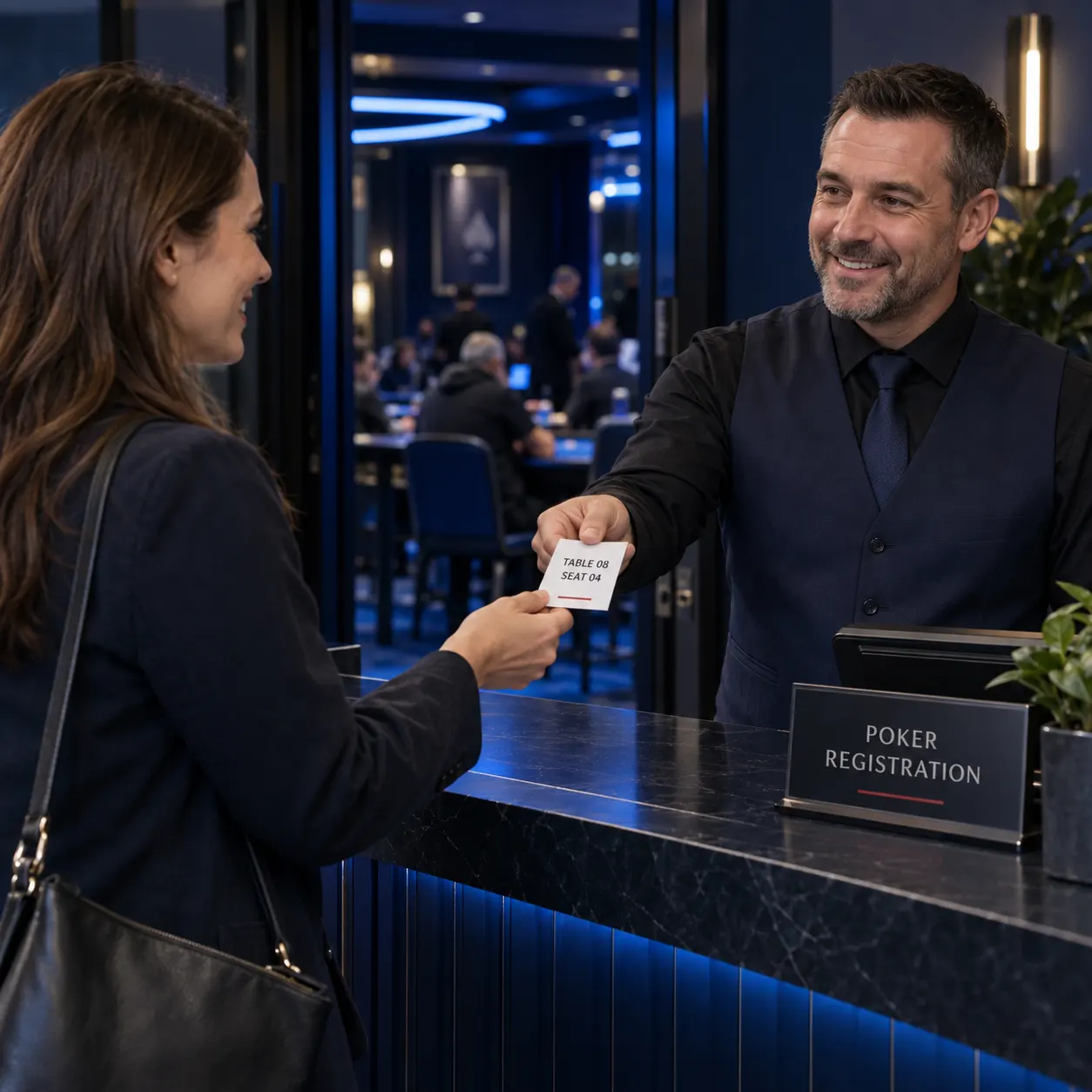
At reception, explain that you are visiting for the poker tournament. Once you reach the poker desk, confirm the event name and total entry cost before paying.
Keep your registration receipt or ticket and follow the staff’s instructions. Tournament seats are commonly allocated rather than chosen; for example, PokerStars Live uses random seat assignments.
When you sit down, tell the dealer it is your first live tournament. A simple “I know the basics, but I’m new to playing live” is enough.
Check your starting stack and ask about any unfamiliar chip denominations. Find the tournament clock, which shows information such as the current level and time remaining.
Ask procedural questions, but make your own playing decisions: asking how much a call costs differs from asking whether you should call.
Good habits at the table
Essential live poker rules and table etiquette
Follow the venue’s rules. The Poker Tournament Directors Association rules provide a reference; check which rules your organiser uses.
Act in turn and state your intentions
Wait for your turn. Spoken actions can be binding, so ask about an unclear bet before saying “call” or “raise”.
Understand the single oversized chip rule
Facing a bet, one oversized chip without a declared raise counts as a call under TDA rules.
Facing 200, silently placing a single 1,000 chip calls 200. To raise, announce “raise” and the total before moving the chip.
Avoid string bets
Putting chips forward, then returning for more without declaring your raise, can be ruled a string bet. State the full amount first or move it forward in one motion. See the TDA betting rules.

Respect other players and the hand in progress
Keep cards visible and protected, and arrange chips so denominations and stack sizes can be seen. Avoid commenting on a hand while others are still playing it, even after you fold.
Keep your phone away during hands and check the venue’s device policy. Do not seek advice from friends while making a decision. PokerStars Live’s rules illustrate restrictions on assistance, devices and disruptive behaviour.
If something seems wrong, ask the dealer to pause and involve the floor manager. You do not need to argue with another player or decide whether they are an “angle shooter” exploiting an ambiguity.
Keep an eye on the clock
Blinds, antes and keeping track of your stack
Blinds are forced bets that rotate around the table. An ante is an additional compulsory contribution; some tournaments collect it from each player, while others use a big blind ante.
Watch the tournament clock and listen to announcements so you know when the amounts change. Ask the dealer if you are unsure what to post.
Think about your stack in big blinds as well as total chips. With 12,000 chips and a 400 big blind, you have 30 big blinds. If the big blind rises to 800 while your stack stays unchanged, you have 15.
This helps explain why waiting indefinitely for a perfect hand is not a complete tournament strategy. Concentrate on understanding the situation and making deliberate decisions rather than rushing or copying dramatic televised plays.

Give yourself enough time
Breaks, table moves and how long tournaments last
There is no universal finishing time. Dusk Till Dawn’s schedules, for example, distinguish events playing to a winner from those with further playing days. Ask your organiser about the expected duration and any return date.
Your own visit could end early if you lose your chips. If you progress, allow enough time to stay rather than relying on a fixed eight- or nine-hour estimate.
Use scheduled breaks for food, water and the toilet, and return before play resumes. If you need to step away at another time, check with the dealer; the tournament continues in your absence.
As players are eliminated, staff may move you to balance tables or close one. Wait for instructions about your new seat and how to carry your chips.
When your tournament ends
Elimination, the final table and collecting winnings
If you lose all your chips, let the dealer confirm the result before leaving. If you are eliminated, a polite goodbye is enough. You are not obliged to re-enter or move into cash games.
Prizes depend on the published payout structure. Reaching the final table does not automatically guarantee winnings in every event, so check how many places are paid.
If you finish in a paid position, follow staff instructions for confirming your result and collecting payment. Keep any documentation they provide.
Afterwards, note a few things you found confusing. Learning how registration, betting and table procedures work is useful progress regardless of where you finish.
A final check before you go
Your first-tournament checklist
Before leaving home, make sure you have:
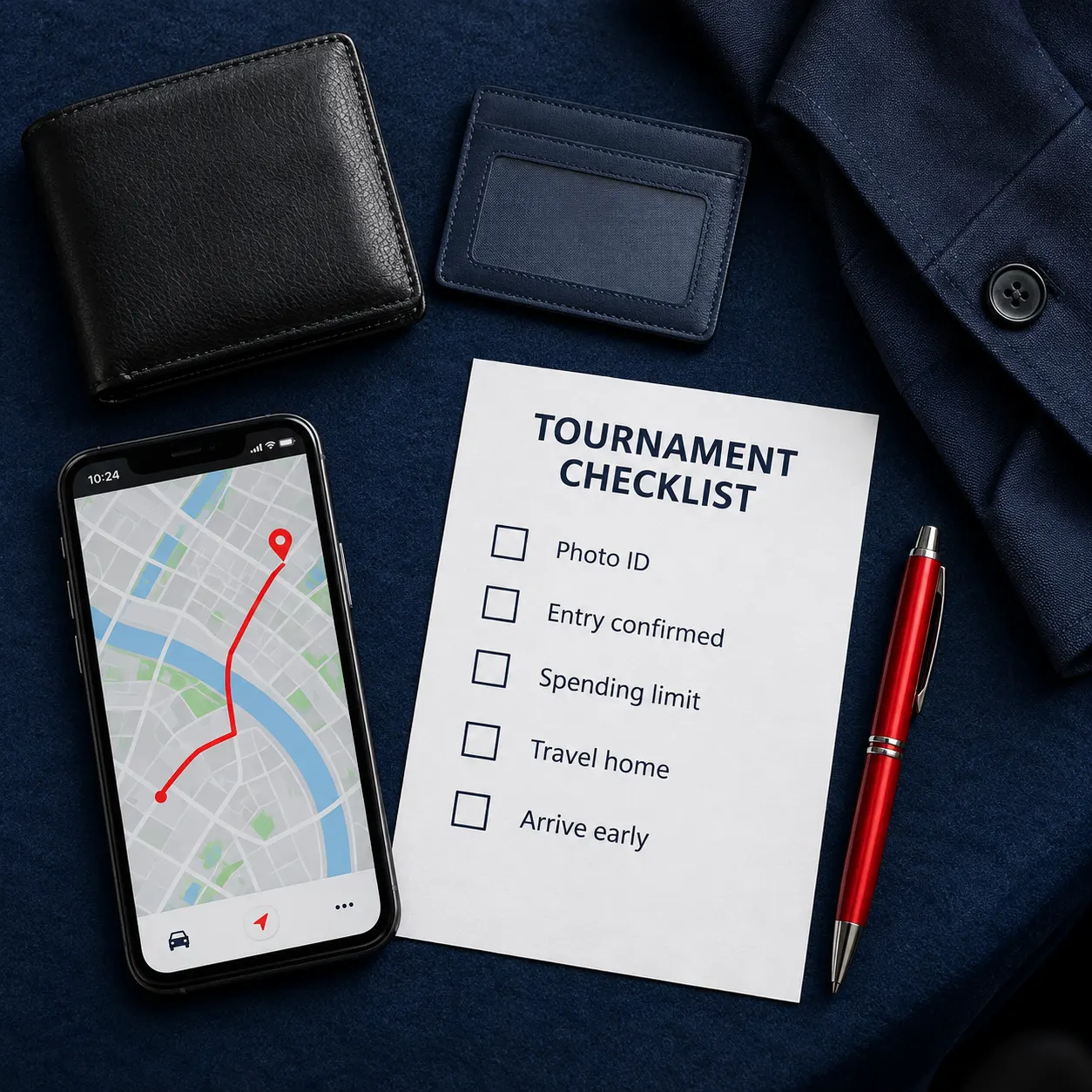
At the table, remember three things: follow the action, state your intentions clearly and ask when a procedure is unclear.
A few more things you may be wondering
First live poker tournament FAQs
Can I enter without qualifying online?
Many open tournaments accept direct entry, subject to eligibility and available seats. Online satellites offer another route into certain live events, but they are not a universal requirement. Check the event’s registration terms.
Should I go with friends?
You can arrange to travel together, but do not expect to sit together. Make separate playing decisions and agree beforehand what happens if one person is eliminated much earlier than the others.
Do I have to show my cards at showdown?
Showdown is when remaining players reveal their hands. Showing requirements depend on the situation. Follow the dealer’s instructions; when required to show a Texas Hold’em hand, expose both cards clearly. See the TDA showdown rules.
What if I make a mistake?
Explain it promptly and let the dealer or floor manager resolve it. A mistake may still have consequences, but asking for help is more useful than trying to undo an action yourself.
Your next step
Find a tournament that suits your first visit
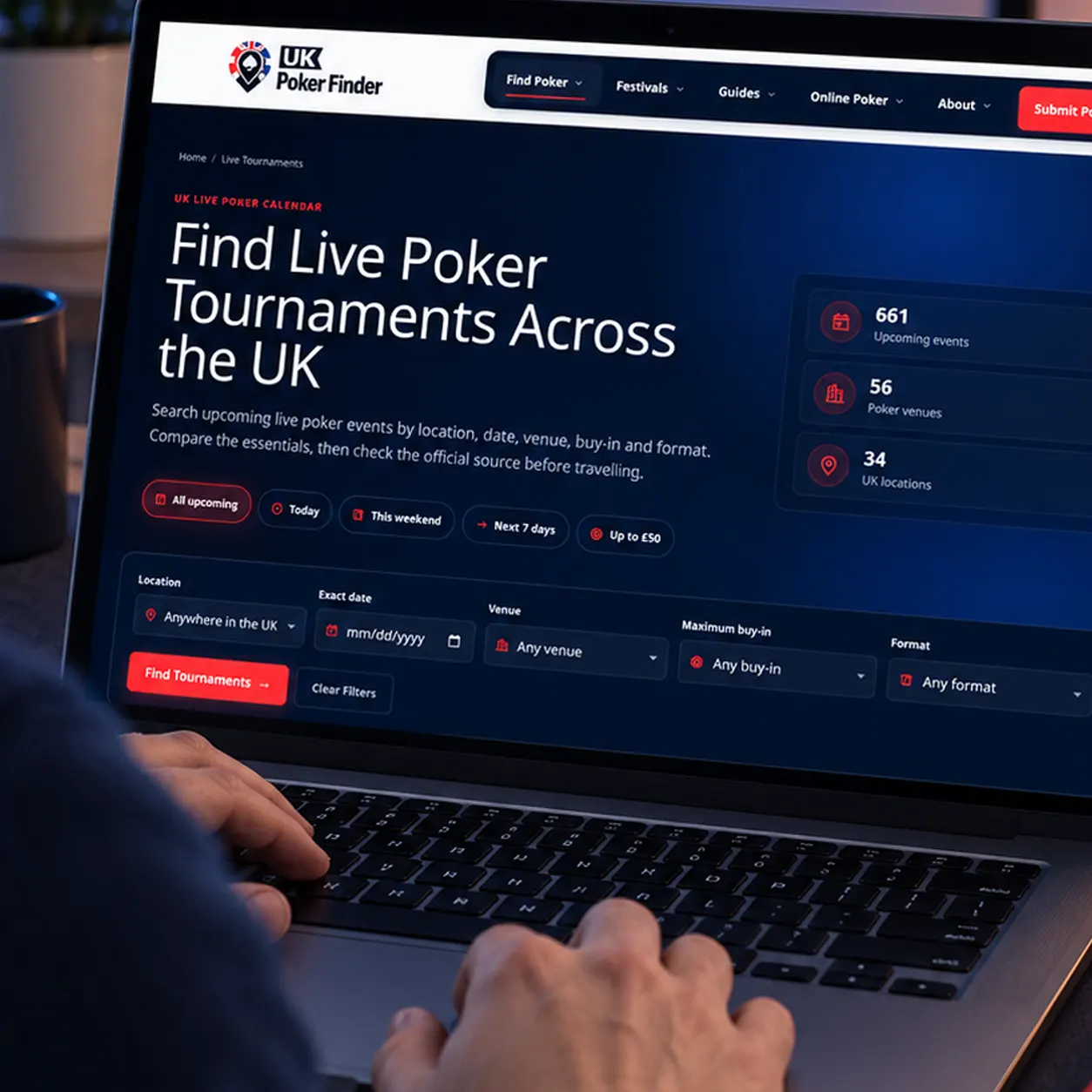
Use UKPokerFinder to explore live poker tournaments and venue information, then confirm the latest details directly with the organiser before travelling.
Choose an affordable event, give yourself time to settle in and approach the experience as a chance to learn. You do not need to look like a regular to take your seat.